
Research
Ecological Monitoring Strategy
At Indo Ocean Project, we conduct nine ongoing research projects across our ocean observatory locations in Indonesia. These projects, along with several independent research initiatives in collaboration with university partners and marine research fellows, focus on advancing our understanding of marine ecosystems. Utilizing highly trained research divers from our internship program, we conduct essential fieldwork contributing to critical scientific research and conservation efforts.

Conservation Management Plan
Want to learn more about what we do?
Read our full 50-page report on our ecological monitoring projects, educational outreach, and program development.
Publications
Explore our recent publications to stay updated on our marine research and conservation projects. Discover the latest findings and insights from our ongoing work in Indonesia.

BRUV
Baited Remote Underwater Video surveys

Roving Survey
Underwater visual census and fish stock count

Benthic Survey
Coral coverage and sessile invertebrates surveys

Coral Restoration
Coral nursery development and maintenance

Reef Assessment
CoralWatch and coral health assessment

SWQ Testing
Sea Water Quality test and ocean chemistry monitoring

Mangrove Restoration
Establishment and reforestation of mangrove forests

Marine Debris
Coastal, community, and in-water marine debris assessment

Citizen Science
Marine megafauna and species catalogueing

Bira Project Annual Report - 2023
Access the complete findings from our 2023 ecological monitoring at the Bira Project. This 133-page open access report shares the data, insights, and recommendations that will help shape the future of marine management in South Sulawesi.
Made possible by the dedication of the Indo Ocean team!
BRUV
Baited Remote Underwater Video surveys
Introduction
Baited Remote Underwater Video (BRUV) is a technique used globally to study the abundance and diversity of elasmobranchs and predatory fish. This method provides valuable data on population dynamics, behavior, and species diversity with minimal environmental impact. BRUVs are particularly useful in monitoring changes in reef fish diversity over time.
Methodology
GoPro cameras mounted on weighted frames with bait cages. With the help of our training research diver interns, these are deployed at depths of 4m to 40m, facing down current, for 60 minutes. Environmental variables such as water current, salinity, depth, turbidity, and temperature are recorded. Videos are analyzed by trained interns who count and document all visible elasmobranchs and commercially valuable fish species.
Results/Outcomes
The BRUV project aims to estimate and compare the relative abundance of predatory fish species inside and outside marine protected areas (MPAs). Data collected helps in developing effective marine park management strategies and contributes to the establishment or improvement of MPA zoning requirements across project locations.
Publications
Explore recent research leveraging our BRUV data to enhance global marine collaborations and publications.
1. Directed conservation of the world’s reef sharks and rays
2. Widespread diversity deficits of coral reef sharks and manta rays
3. Global status and conservation potential of reef sharks
4. Who rules the coral reef when sharks are absence: effect of reef sharks removal in coral reef ecosystem (pending)


Benthic Survey
Coral coverage and sessile invertebrates surveys
Introduction
Benthic Surveys assess coral reef health by documenting benthic composition, including coral and macroalgae coverage. This method is essential for tracking ecological changes over time and informing conservation efforts in marine protected areas.
Methodology
Surveys are conducted using a 50x50cm quadrat with a camera mounted to capture high-resolution photos every 3-5 seconds along predetermined transects. Surveys are performed at various depths (20m, 15m, 10m) and analyzed using software to identify benthic types and coral coverage.
Results/Outcomes
Data from benthic surveys is used to monitor coral coverage and composition, disease, and bleaching events. This information is vital for assessing reef health, guiding restoration efforts, and contributing to publications and independent research.
Publications
Explore recent research leveraging our BRUV data to enhance global marine collaborations and publications.
2. Abundance and Widespread Distribution of the Coral-Killing Sponge Chalinula nematifera in a tourism-dependent marine protected area in Indonesia (working title, pending)


Reef Assessment
CoralWatch and coral reef health assessment
Introduction
Coral Reef Assessments are critical for monitoring the health of coral reefs, which are vital for marine biodiversity and ecosystem stability. These assessments focus on tracking individual coral colonies to detect early signs of stress, such as bleaching or disease, and to monitor their recovery over time.
Methodology
Indo Ocean Project employs the CoralWatch method, where a set of corals at our house reefs are tagged and monitored regularly. Each tagged coral colony is assessed for health indicators, including color changes, which are recorded using a standardized color reference card. This method allows for the consistent monitoring of coral health and the early detection of bleaching or disease.
Results/Outcomes
CoralWatch
CoralWatch is a citizen science initiative founded in 2022 by the University ofQueensland. They provided tools for monitoring coral health using a simple color chart to assess coral bleaching. This program enables anyone to contribute to coral conservation by collecting and submitting data from reefs around the world.


Coral Restoration
Coral nursery development and maintenance
Introduction
Coral Restoration involves re-establishing healthy coral populations on degraded reefs. This process is crucial for maintaining ecosystem balance and preventing trophic cascades caused by coral loss.
Methodology
Interns undergo a coral ecology and restoration course, learning to identify and transplant coral species. Restoration efforts involve planting coral colonies in nurseries and monitoring their growth and health over time. Regular maintenance and assessments ensure the success of the restoration sites.
Results/Outcomes
Restoration efforts aim to promote new coral growth, bridging healthy ecosystems and providing data on the success of different restoration techniques. This information supports future restoration projects and contributes to scientific publications on coral recruitment and ecosystem health.
As of 2024 we have successfully planted 16,000 corals across our three project locations
Publications
Our Reef Restoration techniques are the focus of ongoing research aimed at continuous improvement and sharing insights with the coral gardening community.
2. Coral restoration shifts structural complexity, fish assemblages, and benthic communities in an Indonesian coral reef (pending peer review)


Roving Survey
Underwater visual census and fish stock count
Introduction
Roving Surveys are rapid species assessment techniques designed to collect data on species diversity, sighting frequency, size, and abundance of indicator species. This underwater visual census method is crucial for conservation research, providing a comprehensive overview of marine biodiversity.
Methodology
Research divers complete rigorous species identification training and sizing workshops. Surveys are conducted by teams of 3-8 divers who record all correctly identified indicator species over 20cm during a 30-minute dive. Data is collected on slates and consolidated into the Indo Ocean Project database.
Results/Outcomes
Publications


SWQ Testing
Sea water quality tests and ocean chemistry monitoring
Introduction
Water Quality Testing assesses abiotic factors affecting marine ecosystems. Monitoring water chemistry is crucial for understanding the impacts of climate change and pollution on ocean health.
Methodology
During surveys, water samples are collected and tested for various parameters, including oxygen, pH, salinity, nitrates, phosphates, and potassium. Tests are conducted using probes and kits, with data recorded at the survey site.
Results/Outcomes
Publications




Mangrove Restoration
Establishment and reforestation of mangrove forests
Introduction
Mangrove Restoration involves cultivating and transplanting mangrove seedlings to restore degraded coastal habitats. Mangroves are vital for coastal protection, carbon sequestration, and supporting marine ecosystems.
Methodology
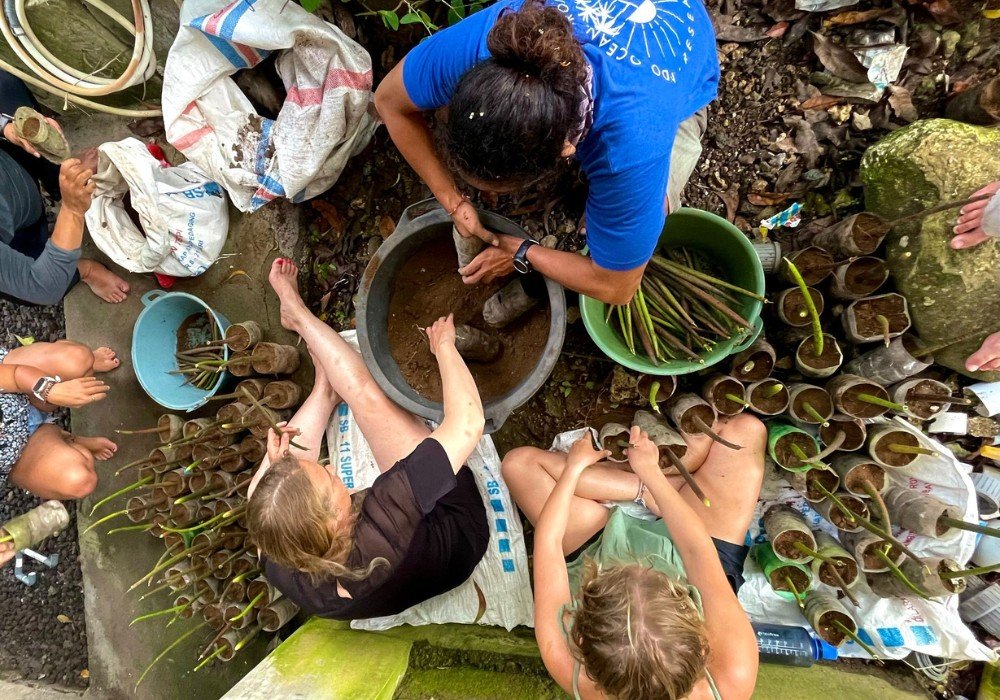
Interns collect mangrove propagules, which are grown in nurseries with optimal conditions for growth. Once seedlings reach a certain size, they are transplanted to restoration sites, with growth and survival monitored regularly.
Results/Outcomes


Marine Debris
Coastal, community, and in water marine debris assessment and dive against debris
Introduction
Marine Debris assessments address the issue of ocean plastic pollution, which has severe impacts on marine life and ecosystems. These assessments involve removing debris, sorting, and counting or weighing the trash.
Methodology
Clean ups are conducted on beaches, underwater, and in communities to collect and categorize debris. Data on debris type, weight, and environmental conditions is recorded and submitted to global databases like PADI AWARE Dive Against Debris.
Results/Outcomes


Citizen Science
Marine megafauna and species cataloguing
Introduction
Citizen Science engages the public in scientific research, allowing non-scientists to contribute valuable data to conservation projects. Platforms like iNaturalist enable users to log and share observations of marine species.
Methodology
Interns and volunteers use underwater cameras to photograph and identify marine species, uploading data to citizen science platforms. Training in species identification and data recording ensures high-quality contributions.
Results/Outcomes


