
Selene Gaiani – Project Manager
I’m thrilled to present the first quarterly report of the new year from Penida. While the rainy season marked the start of the year, it did so with much joy and excitement for our team.
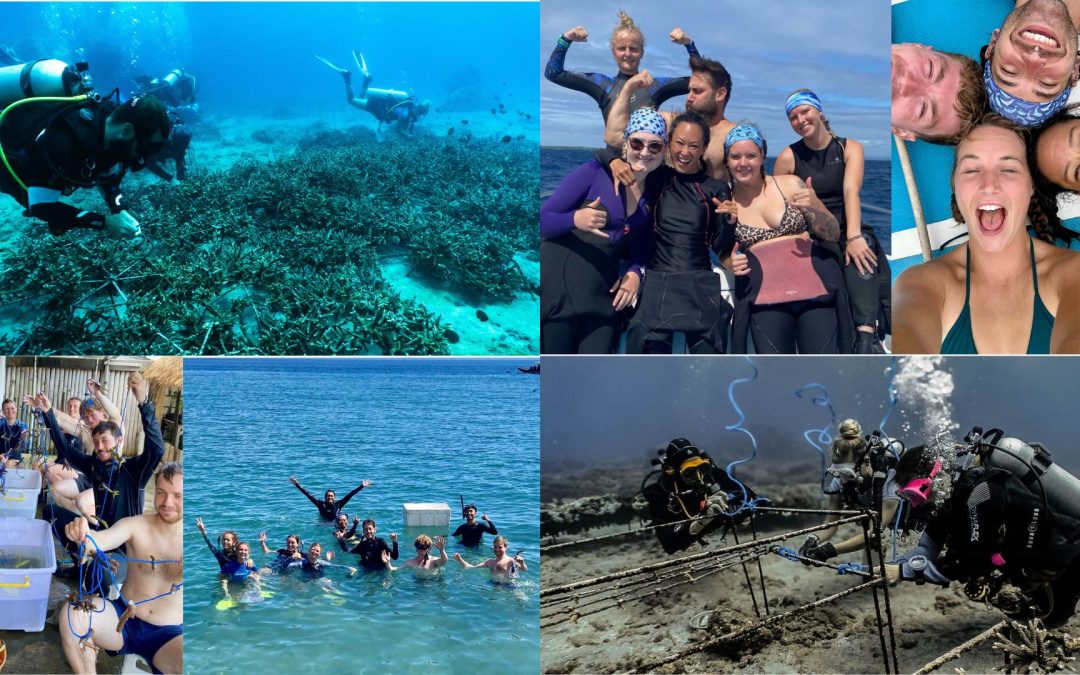
Over the past three months, we have proudly graduated 17 new dive professionals and researchers. Congratulations once again to all of them for their hard work and dedication: Laura Chapel, Connor Ferguson, Nicki Adle, Juno Strauss, Joelle Grossman, Line Van der Sichel, Olive Barnett, Romee Lek, Sophie Beutel, Max Shaw, Cyril Perrin, Chloe Long, Mackenzie Mulligan, Benjamin Erb, Audrey Garrigue, Anouk Noppen, and Orlando Kirby-Knox.
A special congratulation goes to Laura Chapel and Kert, who have continued their professional development by becoming instructors. We wish you both all the best in your future endeavours! Another noteworthy achievement comes from our staff members, Ilham and Kristova, who both earned their Divemaster certifications. We are incredibly proud of you both – your dedication to ensuring quality data collection and your contributions to Indo Ocean Project’s mission are truly valued.


In terms of scientific achievements, our data collection efforts have continued to thrive. We’ve completed 36 Roving Surveys, 12 BRUVs, 12 Benthic Surveys, 6 CoralWatch dives, and 6 Dives Against Debris. These efforts have provided us with valuable insights into the health of our marine ecosystems, helping us shape our ongoing conservation initiatives. Our interns have played a crucial role in ensuring accurate data collection across all these research activities.
Our collaboration with Nuansa Pulau remains strong, with interns actively contributing to coral restoration efforts on the northern coast of the island. Additionally, our interns have participated in several professional development workshops. These include IDC Workshops with Purple Dive and Blue Corner, as well as Freediving Workshops with Pure Dive Resort and Freediving Nusa.
Despite the rainy season, which nurtured the green jungle of Penida, we’ve had some remarkable ocean sightings. These include hawksbill turtles (Eretmochelys imbricata), green sea turtles (Chelonia mydas), reef mantas (Mobula alfredi), Indonesian wobbegongs (Erectolobus leptolineatus), and brownbanded bamboo sharks (Chiloscyllium punctatum). We were also fortunate to encounter several rare megafauna species, including mangrove whipray (Urogymnus granulatus), marbled stingray (Taeniurop meyeni), Sicklefin Devil Ray (Mobula tarapacana), Sperm Whale (Physeter macrocephalus), Spotted eagle ray (Aetobatus narinari), Whale Shark (Rhincodon typus), Minke whale (Balenoptera acutorostrata), and a few bumphead mola (Mola alexandrini).

In the past quarter, 39 ecology workshops and 45 divemaster development workshops were conducted in-house. These workshops focused on deepening understanding of the marine ecosystem, with insights from marine biologists. The goal was to integrate this knowledge into the professional development of interns, ensuring they not only become skilled dive professionals but also develop the ability to share their passion for and knowledge of the fragile marine ecosystem with tourists.
Looking ahead, we are excited to see what the new season will bring in terms of further scientific breakthroughs and the continued inspiration of our interns. Thank you to everyone who has contributed to the success of the Indo Ocean Project so far, and here’s to another impactful year ahead!
Marina Lee – Program Coordinator
I’m delighted to share my first quarterly report as the Program Coordinator for the Penida Project. After wrapping up my time as an intern with Indo Ocean Project in Raja Ampat in 2023, I am thrilled to return to this project and collaborate with such a passionate and dedicated team of dive professionals and scientists, all committed to protecting the remarkable marine environment we are fortunate to be part of.
Over the past three months, I’ve had the privilege of undergoing training for my role within the Penida Project. It’s been a great joy to meet our interns and observe their growth into skilled dive professionals. I want to give a special thanks to Selene and Michaela for their excellent training sessions, as well as my colleagues Arya and Tova for their warm welcome – thank you all so much for that!

Since November 2024, we’ve said goodbye to our graduated dive masters, who are moving on to exciting new chapters as instructors, world travelers, and furthering their conservation research. We’ve also welcomed a fantastic group of divers from around the globe, including the UK, New Zealand, Canada, the USA, Belgium, the Netherlands, Australia, France, Switzerland, and Indonesia!


This quarter has been filled with science, fun, diving, and numerous training courses to prepare our interns for their divemaster training. After the arrival and check-out dives, training begins. Some interns dive straight into their divemaster courses, while others begin with their open water, advanced open water, or React Right and Rescue courses. A special thank you to the instructors at Reeflex Divers who play a crucial role in preparing our interns to embark on their divemaster journeys with IOP.
It’s incredibly rewarding to witness each intern in Nusa Penida grow more confident and skilled in the water with every dive!

Dive Against Debris
With the arrival of the rainy season, we’ve had some heavy but quickly passing storms. Unfortunately, the rain brings more debris from the land into the ocean. Since our last report, we’ve carried out 6 Dive Against Debris and collected nearly 23,67 kg of trash. The types of debris we’ve encountered include familiar items like fishing lines tangled around the reef, harmful plastic packaging, cutleries and bottles, but also aluminium spray cans and batteries.
Due to the rainy season, some of our community clean-ups have been postponed, but our interns remain dedicated to keeping Penida clean. Whenever weather permits, they collect trash on land or during survey and training dives, doing their part to help protect the environment.
Continuing Ocean Talk
Following the success of our first Ocean Talk event, we hosted another one this quarter, bringing together an inspiring group of speakers from Ocean Gardener, Konservasi Indonesia, Nuansa Pulau, WWF Indonesia, Marine Megafauna Foundation (MMF), Elasmobranch Project Indonesia (EPI), Blue Corner Conservation, Friends of Nature, People and Forest (FNPF), MERO, Seven Clean Seas, and Anna Plucincka from the University of Essex. We were also joined by IOP’s own amazing marine biologists, Rinaldi Gotama and Kristova Indrataruna, who shared exciting insights on recent findings and emerging trends in marine conservation.
The event sparked engaging discussions among speakers and attendees on a variety of important topics, including the discovery of the largest coral colony in the world, community engagement for conservation, elasmobranch conservation, reef manta research in Nusa Penida, the spread of coral-killing sponges, waste management, and coral conservation through traditional and modern methods. The enthusiastic feedback we received has inspired us to plan more Ocean Talks in the future!


Looking ahead, I am excited to welcome new interns and I am equally eager to see our current interns graduate into talented divers and scientists. It’s going to be an exciting journey ahead, and I can’t wait to see all the progress we make!
Mangrove Nursery
Following our successful mangrove planting initiative in Semaya, which involved local communities and high school students, it’s time to replenish our mangrove nursery with new propagules.
We’ve ventured to the mangrove forest in Nusa Lembongan where we collected 100 propagules and, with the help of our interns, we carefully planted them in the nursery. These young mangroves are growing strong, but still need time to mature before they can be planted in the wild. With continued care, these mangroves will play a vital role in restoring and strengthening Penida’s coastal ecosystems!
Kristova Yubilius – Jr Marine Biologist
Science and biodiversity report
Compared to the previous quarter, when tourism was at its peak, the current low season has helped us stay ahead with our scientific work. Over the past three months, we have conducted: 41 roving surveys, 12 BRUV drops, and 14 benthic surveys. These scientific methods remained our primary method to assess the health of Nusa Penida ecosystems by evaluating important fish biomass, presence of high trophic predators, and benthic biodiversity.
The low season presented us with a rare opportunity to deploy a BRUV at Manta Point—something we’ve never attempted before due to the area’s high dive traffic. Since BRUVs require at least one hour of human absence to be considered successful, deploying one in such a popular site has always been a challenge. The only previous exception was just after the pandemic, before the country fully reopened.
This time, we managed to capture some incredible footage of reef manta rays (Mobula alfredi), blue-spotted stingrays (Neotrygon caeruleopunctata), and a yellow-edged moray eel (Gymnothorax flavimarginatus). However, despite strategical placement of the BRUV, divers still ended up in the middle of the footage. Unfortunately, this meant the BRUV deployment was unsuccessful. Just bad luck that day—but an exciting attempt nonetheless!
What an incredible quarter it has been for marine wildlife sightings! One of the most exciting highlights was the Sicklefin devil ray, documented by our partners at the Marine Megafauna Foundation (MMF)—the first-ever recorded sighting of this species in Nusa Penida.


Equally thrilling was the presence of both sperm whales and minke whales, both were elusive in Penida’s waters for years. This quarter, both were spotted from the boat between dives, making for an unforgettable moment.
Meanwhile, the appearance of a fashionably late bumphead mola outside their usual season is a surprise. This mysterious animal continues to elude me underwater. Maybe, someday I will have a chance to see them. Either way, their sightings continue to reinforce Penida’s importance as a sanctuary for marine megafauna.


Citizen Science Contributions
Our commitment to citizen science remains strong. We conducted 34 citizen science dives and collected 24 turtle cheek photos, 4 manta belly photos, and 7 elasmobranch photos. As always, we encountered many hawksbill turtles (Eretmochelys imbricata) despite IUCN listed the species as critically endangered and a few encounters of brownbanded bamboo sharks (Chiloscyllium punctatum).
A huge success for citizen scientists of Nusa Penida! As of this quarter, our community in iNaturalist has documented more than 1000 species of marine organisms. An amazing milestone worth celebrating. We liked to thank everyone, IOP interns and naturalists, who have contributed a photo or two. This allows us to better understand and be proud of the biodiversity of Nusa Penida as we continue our work. Please check out our page here.
Coral Restoration: Surviving the Floods
I am pleased to report that we have completed two more coral restoration dives this quarter and brought the total number of fragments planted to 1583. As part of our ongoing efforts to enhance the coral diversity in our nursery and restoration site, we have expanded beyond our usual reliance on fast-growing Acropora corals (Acropora sp.). This quarter, we introduced Porites corals (Porites cylindrica).
However, Crystal Bay suffered yet another devastating flood due to the heavy rainfall that has battered the island. A portion of the island’s runoff is directed toward Crystal Bay, where our nursery and restoration site are located.


On the day of the flood, I was returning from a dive at Manta Point. The towering cliffs along the coastline had suddenly formed waterfalls, pouring murky waters into the ocean. Crystal Bay, usually famous for its crystal-clear waters, had turned chocolate from the runoffs. Just after we had planted new coral fragments the day before, and I feared for their survival.
As soon as the waters cleared, I checked on our corals. To my relief, all the fragments survived with minimal mortality. This was a huge win for the team, especially after the devastating 2021 flood, which wiped out most of our nursery and restoration site.
However, our work is far from over. The flood brought with it an alarming amount of trash, serving as a stark reminder that many Nusa Penida residents and tourists still do not properly dispose of their waste. This is an ongoing challenge that we must continue to address.
Want to join the team?
We are always seeking hard working and enthusiastic ocean lovers to join our award-winning and innovative divemaster and research diver internship. Contact us and apply online today!
Recent Comments