
Selene Gaiani – Head Instructor
I’m very pleased to write this quarter’s report for the Penida Project. Having recently returned to cover the Senior Instructor position, it has been amazing to be back in the water and in the classroom and to see first-hand the development of our training programme. Watching our students grow in confidence, improve their skills and reach their goals, together with seeing the work and dedication of our staff, is something to be extremely proud of.
As the high season in Bali and Nusa Penida got underway, we welcomed sunny days, cooler waters and plenty of activity around the project. It has been another busy quarter, with our interns involved in training, research, data collection, workshops and the everyday life of the Penida Project.

We are very happy to congratulate our 16 graduates this quarter: Chanidapha Rungsritachathon (Thai), Talullah Moore (USA), Natividad Sanchez (Argentina), Tamara Pietrucik (Polish), Toby Moeller (German), Anthony Donovan (USA), Alyssa Forget (Canadian), Nicholas Jefferies (USA), Amelie Maurice (French), Aleksandra Higson (UK), Tristan Moss (USA), Krisztian Simon (Hungarian), David Caviezel (Swiss), Isla Will (Australian), Alex Wargo (USA) and Sherly Wong (Indonesian). Congratulations to all of you, and thank you for choosing Indo Ocean Project, contributing to our research and becoming part of our community.
It is always exciting to see where our graduates go next. Some continue diving simply as a passion, others pursue careers in the diving industry and continue with Instructor training, while others move towards marine conservation and research, looking for employment or continuing their education. Whatever your next step, we know you will be great advocates for our oceans.


Training has remained a major focus this quarter, with 42 Diver Development Workshops and 45 Ecology Workshops completed. These sessions continue to be an important part of helping our interns become confident and independent divers while developing their understanding of marine ecosystems and the importance of responsible diving and conservation.
The Penida Project is also always teaming with exciting research activities and science talks. Our interns have continued contributing to data collection while learning more about the species and ecosystems they encounter underwater. The combination of training, research and conservation is what makes project life so rewarding, and it is great to see our interns becoming increasingly confident in both their diving and their scientific knowledge.
As we look towards the next quarter, we are excited to continue developing our training programme, research activities and, our community. To all our graduates, thank you once again for being part of Indo Ocean Project. Wherever your next adventure takes you, you will always be part of the IOP family. And to everyone currently at Penida: keep learning, keep asking questions and make the most of every dive!
Andy Handoko – Program Coordinator
A lot has happened since I wrote my last quarterly report in May, and I’m happy to say that this role has not lost its magic for me. If anything, that feeling has only grown stronger.
Over the past few months, the interns have been braving the cold waters on the west and south sides of Penida, and their perseverance was rewarded with sightings of mola (Mola alexandrini). Despite the overwhelming crowds at Crystal Bay and Manta Point, we’ve continued to enjoy every encounter the ocean has given us, always looking forward to the next surprise that nature has in store.
One of the things I continue to love most about this program is the people. Our current interns come from incredibly diverse backgrounds, and they never cease to surprise me. Even though everyone is working toward the same goal, their different experiences, cultures, and personalities make every day feel fresh and exciting.

As much as the interns have learned from me, they have also taught me so much in return. Whether they realize it or not, each of them has contributed to my growth, both professionally and personally. That, to me, is one of the most rewarding parts of this position. I hope to keep learning from every new group that joins us. We’ll soon be welcoming interns from Japan, the UK, Switzerland, India, the United States, and Canada, and I’m genuinely excited to meet them and grow together over the coming months.
That’s all from me for this report. Until my next quarterly report, cheers!


Kristova Indrataruna – Project Marine Biologist
Science and Biodiversity report
It’s MOLA SEASON!!! Nusa Penida enters one of its most exciting times of year. Cooler waters, bigger waves, and an influx of visitors all come together as divers arrive with one goal in mind: catching a glimpse of the incredible ocean sunfish, or mola.
But while mola sightings are one of the highlights of the season, there is much more happening beneath the surface. Over the past three months, the IOP Penida team and our dedicated interns have continued monitoring the reefs, documenting marine life, contributing to citizen science, and carrying out conservation activities across the island.
During this period, we conducted 38 roving fish surveys, 12 benthic surveys, and 12 BRUV deployments. Excellent conditions in Penida allowed us to catch up on our previous targets from last quarter. All of this monitoring data was collected by our dedicated and hard-working interns, whom I would like to sincerely thank.
Nusa Penida once again delivered some fantastic megafauna encounters this quarter. Our surveys recorded sightings of whitetip reef sharks (Triaenodon obesus), Indonesian wobbegongs (Orectolobus leptolineatus), and marbled rays (Taeniura meyeni). One of the more surprising highlights was a resident juvenile spotted eagle ray (Aetobatus ocellatus) at Manta Point. This individual can occasionally be seen swimming alongside the reef mantas, making an already spectacular dive even more memorable. We also had an exciting whale shark (Rhincodon typus) encounter, while perhaps the most unexpected record of the quarter was an Australian guitarfish (Rhynchobatus australiae), documented through iNaturalist.


And, of course, it wouldn’t be mola season without a few encounters with the spectacular bumphead mola (Mola alexandrini)!
Alongside these exciting sightings, we continued to encounter some of Penida’s familiar residents, including hawksbill turtles (Eretmochelys imbricata), green sea turtles (Chelonia mydas), bottlenose dolphins (Tursiops sp.), reef mantas (Mobula alfredi), and brownbanded bamboo sharks (Chiloscyllium punctatum).
Every encounter adds another piece to the growing picture of Nusa Penida’s marine biodiversity.
Citizen Science
Our commitment to citizen science remains strong. During this quarter, we completed 27 citizen science dives, documenting wildlife encounters and contributing valuable observations to our research partners and databases. Our team added 7 turtle cheek identification photos, 1 manta belly shot, and 1 elasmobranch image to our database.
These photographs may seem like small contributions, but together, repeated observations can help researchers identify individuals, track animals over time, and better understand how marine species use the waters around Nusa Penida.

Our conservation work also extends beyond documenting wildlife. Through five Dive Against Debris dives, we removed 24.1 kg of marine debris from Crystal Bay. We also conducted four beach clean-ups, collecting an impressive 322.63 kg of marine debris. To keep track of the health of Penida’s reefs, we also completed three CoralWatch dives, contributing to long-term monitoring of coral health and bleaching trends.
Mangrove planting
Our mangrove restoration efforts continued in Semaya, where we planted 111 mangrove propagules this quarter. However, planting was only part of the job. Since our previous planting, several trees had fallen and rubbish had accumulated around the area. So, along with our propagules, we brought saws, gloves, and plenty of trash bags! It was encouraging to see that several of the mangroves planted previously had survived and were continuing to grow. We hope these young trees continue to establish themselves and thrive before our next planting. Mangrove restoration is a long-term commitment, and every surviving seedling brings us one step closer to a healthier coastal ecosystem.


Coral Thermal Testing Aquarium
We are also expanding our scientific activities in Nusa Penida through a new coral aquarium and thermal experiment in collaboration with Dr. Tries Blandine Razak.
The aquarium will allow us to conduct controlled experiments investigating how corals respond to changes in temperature. Understanding coral thermal tolerance is particularly important as ocean temperatures continue to rise and coral bleaching events become an increasing concern.
By combining field observations with controlled experiments, we hope to contribute to a better understanding of coral resilience in Nusa Penida.
PopStar
We are also excited to collaborate with Seaforms, a Singaporean startup developing a new approach to reef restoration using carbon-fibre rods to construct reef stars. Compared with conventional reef stars, these PopStars are lighter, modular, and easier to assemble, making transportation and deployment more practical. Since their deployment in Nusa Penida, we have been closely monitoring their health and structural integrity, while providing feedback on any adjustments that could improve their design and durability. With Nusa Penida’s challenging conditions and often rough seas, the PopStars are being put to the test. If they can withstand Nusa Penida, they can probably withstand just about anywhere.

We look forward to continuing this collaboration and exploring how this innovative technology can support coral restoration efforts and contribute to future restoration projects in Nusa Penida.
Sherly – Research Assistant
While this quarter marks a goodbye for me to the Penida Project, it also marks the beginning of an exciting new chapter as I prepare to join the Bira Project.
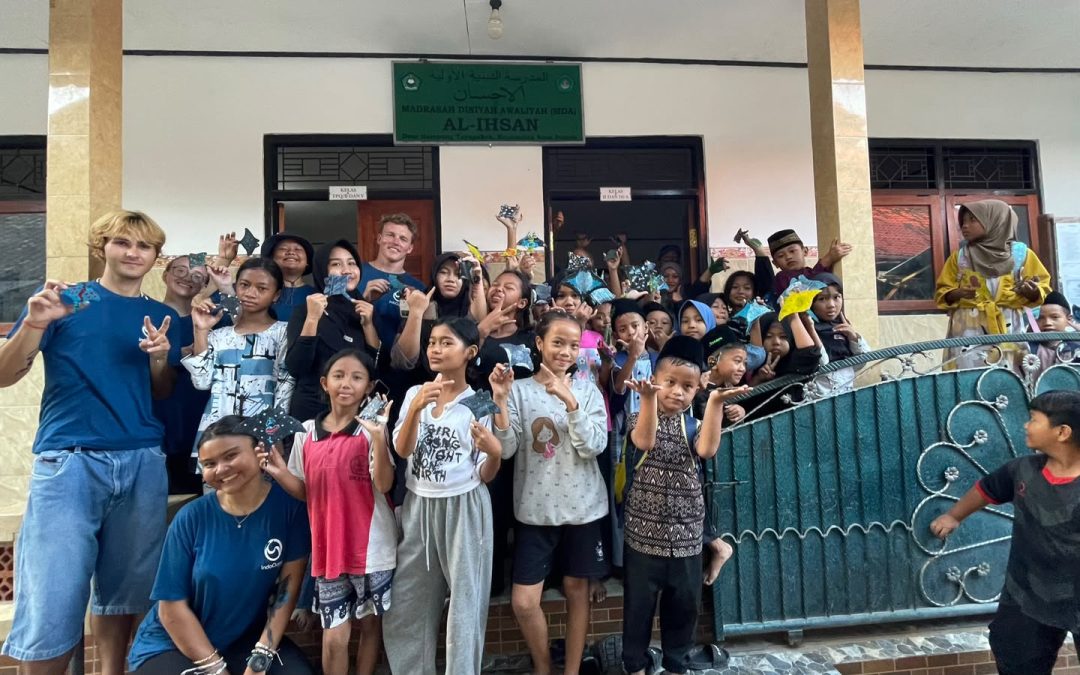
Hi, I’m Sherly, currently the Research Assistant for the Penida Project, and soon I’ll be stepping into a new role as Project Instructor for the Bira Project. Looking back on the past few months, one of the moments I am most grateful for was our Community Outreach Day, where our interns spent an afternoon connecting with local children through a simple but meaningful creative activity: painting manta ray cutouts made from cardboard.
Our interns always come from incredibly diverse backgrounds, bringing different cultures, experiences, and perspectives to the project. Seeing those differences disappear as everyone sat together, painted, laughed, and interacted with the children was especially heartwarming. The children brought so much excitement and creativity to the activity, while our interns embraced the opportunity to connect with the community beyond their usual research and fieldwork.


What began as an afternoon of painting became something much more meaningful — a chance to share stories, create memories, and strengthen the connection between our project team and the local community. The joy and energy from both the children and our interns made the day truly special.
As I close my chapter with the Penida Project, moments like this are what I will remember most. I am deeply grateful for the experiences, people, and communities that have shaped my time here, and I look forward to carrying the same spirit of connection, learning, and community into my next adventure with the Bira Project.
Cheers!


Want to join the team?
We are always seeking hard working and enthusiastic ocean lovers to join our award-winning and innovative divemaster and research diver internship. Contact us and apply online today!
Recent Comments