
Valentina Serrazanetti – Senior Instructor
Over the past three months, IOP has made significant strides in dive professional training, conservation engagement, and underwater education. Here’s a snapshot of the incredible progress and accomplishments from this quarter:
We successfully conducted over 60 Divemaster workshops, covering a comprehensive range of skills from technical training to leadership development. Interns engaged in topics such as search and recovery, deep gas planning, and the science of diving—with detailed lessons in physics, physiology, and equipment theory. Training continued all the way to dive leadership, focusing on how to guide and ensure the safety of others underwater
IOP has continued to uphold its belief that every dive is a training dive. Dive professionals and interns practiced skill demonstrations, honed buoyancy techniques, and consistently sought improvement under the guidance of experienced instructors and dive masters. This hands-on, feedback-driven approach has elevated both the technical quality and confidence of our developing professionals.
We’ve proudly certified several outstanding dive professionals this quarter: Alex Kimbrough, who arrived with only 6 dives, completed his Divemaster with over 100 dives and now works on the Ningaloo Reef as a dive professional. Abigail Roberts, returning to finish the program after a pause, became a highly aware and capable dive pro. She now works in seagrass conservation in Cambodia. Eliza Edwards, whose dedication and persistence paid off under close mentorship, is now a knowledgeable and passionate Divemaster who brings heart and skill to every dive.


Our conservation and research efforts took a major leap this quarter, with more than 60 ecology workshops conducted and a new cohort of specialized survey divers trained. Interns played an active role in data collection and restoration, contributing to ongoing projects such as biomass and benthic surveys and the maintenance of our reef restoration site. Being a part of the IOP conservation program offers interns a hands-on, purpose-driven experience that directly impacts the health of the marine environment.
This quarter has been a testament to the power of community, dedication, and experiential learning. We’re incredibly proud of our interns and dive professionals who continue to grow, lead, and contribute both above and below the surface.
Kristova Yubilius – Marine Biologist
Science and biodiversity report
Penida’s high season is just around the corner, which means the science team need to be ready for potential disruption to our activities. Despite this, the past three months have been highly productive. We have conducted 34 roving surveys, 11 benthic surveys, and 13 BRUV deployments. These scientific methods remained our primary method to assess the health of Nusa Penida ecosystems, focusing on important fish biomass, presence of high-trophic predators, and benthic biodiversity.


This quarter also brought some thrilling megafauna encounters. We recorded bumphead mola (Mola alexandrini), Indonesian wobbegong (Orectolobus leptolineatus), brown-banded bamboo shark (Chiloscyllium punctatum) tawny nurse shark (Nebrius ferrugineus), marbled stingray (Taeniurops meyeni), spotted eagle ray (Aetobatus occellatus), and pelagic thresher shark (Alopias pelagicus) in our dives. As always, we encountered plenty of reef manta rays (Mobula alfredii), hawksbill (Eretmochelys imbricata) and green sea turtle (Chelonia mydas) – all frequent sighting in Nusa Penida waters.
Even more exciting were some rare and persistent sightings. Our team encountered a whale shark (Rhincodon typus) in Crystal Bay during a Dive Against Debris dive and baby white tip reef sharks (Triaenodon obesus) at Blue Corner Dive Centre’s coral restoration site, which now appears to be serving as a nursery ground. We also had the rare encounter with the elusive Olive Ridley turtle (Lepidochelys olivaceae) during one of our dives. Though this turtle is known to inhabit the waters of Nusa Penida it is rarely seen. According to our partners at Bulih Bali turtle Conservation, Olive Ridleys nest along the Nusa Penida beaches. Recently, several of the nest was relocated to more protected area under the turtle conservation to prevent hatching failure. Since then, hatchlings have successfully emerged safely and released back into the ocean.


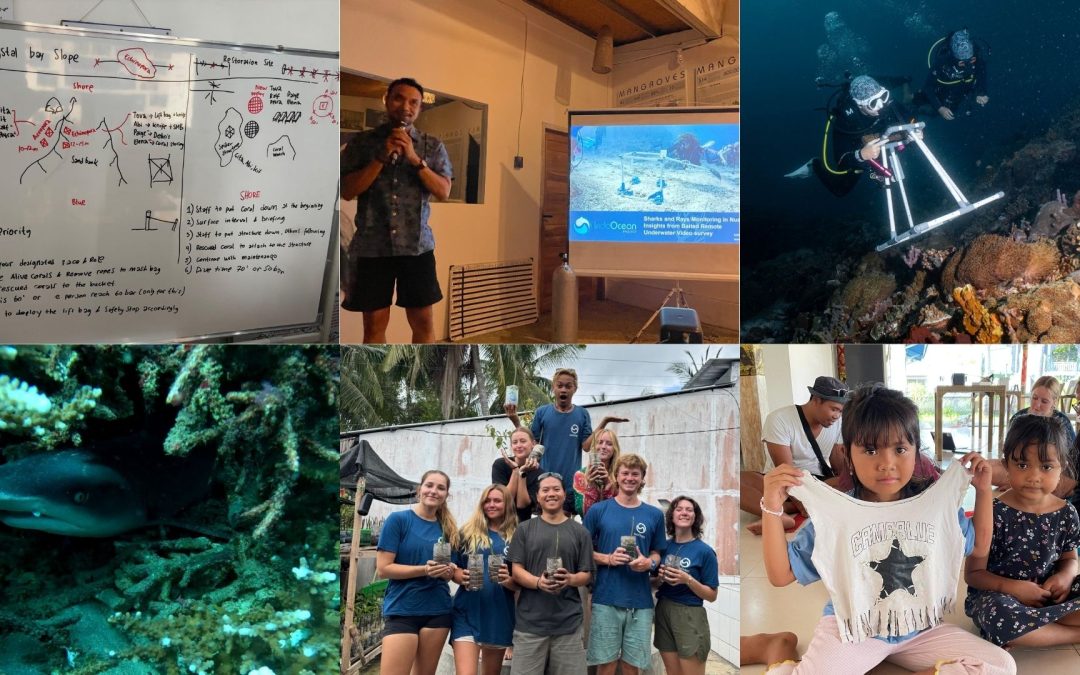
One of the most spectacular moments of the year came during a BRUV deployment dive, when we encountered a school of seven molas – a truly extraordinary and rare sight. The footage was just as remarkable: within the first ten minutes, the BRUV recorded one of the molas alongside an eagle ray and a marbled stingray. It was without a doubt one of the BRUV highlight of the year since I worked with IOP.
We look forward to seeing what the next quarter will bring with even more incredible encounters beneath the waves.
Citizen Science
Our commitment to citizen science remains strong as we continue to document every exciting encounter and contribute valuable data to our partners. This quarter, we completed 21 citizen science dives and added 32 turtle cheek photos, 14 manta belly shots, and 8 elasmobranch images to our database.
From this we submitted nine new turtle individuals to the Internet of Turtles – one green turtle and eight hawksbill turtles – and contributed new records of whale shark, brown-banded bamboo shark, pelagic thresher, and spotted eagle ray into Elasmobranch Project Indonesia database. Meanwhile, our iNaturalist page has grown to 1178 species, thanks to the contributions of IOP interns, tourist, and dive professionals. We are truly grateful to everyone who has helped build this shared resources.
Our conservation work does not stop at recording sightings; it also extends to the health of the reef and surrounding environment. Through six Dive Against Debris dives, we removed 9.44 kg of trash from Crystal Bay. In addition, we conducted five CoralWatch monitoring dives to track the health of corals over time.
Mangrove and coral restoration updates
This quarter brought exciting progress for both our mangrove and coral restoration projects. In Semaya, we planted 70 mangroves together with the local community, creating an opportunity to learn and shared stewardship the ocean that we depend on. We also restocked our mangrove nursery with 174 new propagules, which are growing steadily.
Meanwhile, our coral nursery in Crystal Bay continues to flourish. We added 218 new coral fragments – 88 fragments of Acropora pulchra and 130 fragments of Porites rus. By diversifying the coral species in our nursery, we hope to strengthen reef resilience and biodiversity in our restoration site. These young corals will remain in the nursery until they grow large enough to be transplanted into our restoration site.
After years of hard work, our restoration site has brought in significant progress. The hollow metal structures used has become home of a variety of marine life. We regularly spot yellowedge moray eels (Gymnothorax flavimarginatus), baby oriental sweetlips (Plectorhinchus vittatus), and cuttlefish sheltering among the frames and dense coral colony. It’s encouraging to see the site supporting marine biodiversity while the corals continue to grow.


Community outreach
To inspire future generations to care for their local environment, we visited local communities and hosted an interactive session with children on the importance of reducing waste. During the session, we discussed how trash impacts both land and ocean ecosystems, showing how even everyday items can cause long-term damage. The children were especially engaged when learning about the journey of plastic from land to sea and its effects on marine life. At the end of the session, we shared practical ways to reuse and recycle materials in their daily lives. One highlight was an activity where they transformed old clothes into reusable shopping bags with just a few simple steps. It was wonderful to see their creativity shine, and we hope these hands-on solutions not only inspired them but also encouraged them to bring the ideas home and share them with their families.

Ocean Talks and new paper
As an education and research centre in Nusa Penida, we are committed to expand our understanding of our local ecosystem and learn new tools to support conservation. This quarter, our Ocean Talk featured presentation by our very own Selene Gaiani, Ahmad Ilham, Gita Alisa, and Pascal Sebastian, alongside a special guest appearance from Prof. Sai-Kit Yeung of Hong Kong University of Science and Technology.
- Selene shared her ongoing work with the data from Raja Ampat, where she is investigating correlations between benthic diversity and fish biomass.
- Ilham presented updates on his Dive Suitability Index project, which monitors weather, ocean currents, wind, and tides around Nusa Penida. His goal is to create a tool that can help local dive centres predict dive site conditions.
- Gita discussed her recently published Master’s research on the aesthetic value of corals for restoration efforts. She hopes her findings will inspire coral restoration programs worldwide to design sites that are not ecologically effective but also visually appealing.
- Pascal presented our newly published Penida BRUV paper, which provides updated insights into the elasmobranch abundance in Nusa Penida compared with previous BRUV studies to assess the effectiveness of the marine protected area.
- Lastly, Prof. Yeung introduced his team’s cutting-edge technology that uses AI to identify coral colonies from photographs, trained to recognise species and growth forms.
We look forward to hosting more Ocean Talks in the future, welcoming a wider range of speaker and topics. These events are valuable opportunity to exchange ideas, share knowledge, and foster collaboration across diverse fields of expertise.


Want to join the team?
We are always seeking hard working and enthusiastic ocean lovers to join our award-winning and innovative divemaster and research diver internship. Contact us and apply online today!

Recent Comments